Outdoor Water Filters: LifeStraw’s Range Compared
This article contains affiliate links
LifeStraw started as a humanitarian project — the company’s straw filters were originally developed to help fight Guinea worm disease in parts of Africa without reliable water infrastructure, and LifeStraw is still a certified B Corp that donates a year of safe water to a child for every product sold. That backstory is part of why it became the default name in personal water filters, but the outdoor range has grown well past the original straw, and it’s worth knowing what each tier actually does — and doesn’t — before picking one.
The original LifeStraw: still the cheapest way in
The original LifeStraw is 26.95 €, weighs 46g, and filters up to 4,000 litres — enough, per LifeStraw’s own figures, to last one person roughly five years of regular use, with no shelf life limit before that. It removes 99.999999% of bacteria, 99.999% of parasites (giardia, cryptosporidium), and 99.999% of microplastics, sediment and dirt, through a 0.2-micron membrane filter, and meets US EPA and NSF P231 standards for bacteria and parasite removal.
Worth being precise about what it doesn’t do: LifeStraw’s own comparison chart for this product lists chemicals, PFAS and heavy metals as not removed, and it doesn’t filter viruses either. For hiking in Europe or North America, where the practical risk in most backcountry water is bacterial and protozoal, not viral, that’s an accepted trade-off most reviewers don’t flag as a dealbreaker. For international travel to places with viral contamination risk, it’s not the right tool on its own.
LifeStraw Personal Water Filter
Peak Series: LifeStraw’s dedicated outdoor line
The Peak Series is built specifically for hiking and backpacking rather than travel or emergency use, and comes in a few formats:
- Peak Series Straw (29.95 €) — an upgraded straw filter, sold in two colourways
- Peak Solo (29.95 €) — a similar personal filter with a syringe for backflushing included
- Peak Series Collapsible Squeeze 1L Bottle with Filter (49.95 €) — a soft-flask-style bottle, the closest LifeStraw product to the Sawyer/Katadyn squeeze format below
- Peak Series Gravity Purifier with virus removal (199.95 €) — the one genuine step up in protection: this is LifeStraw’s only outdoor product in the current range explicitly rated for virus removal, aimed at group use or international travel where that matters
That gravity purifier’s price gap versus everything else in the lineup is the point: virus-rated filtration is meaningfully more expensive gear, and LifeStraw, like every brand in this space, reserves it for one dedicated product rather than building it into the cheaper straws and bottles.
LifeStraw Peak Series 1L Bottle
LifeStraw Go: the integrated bottle option
The Go Series bundles the filter into a proper drinking bottle rather than a squeeze system — useful if you’d rather fill, screw a lid on, and drink normally. EU prices run from 44.95 € for the 500ml stainless steel version up to 74.95 € for the insulated 1L stainless steel bottle, with a BPA-free plastic 650ml version at 53.95 €. These use the same core filtration as the straws (bacteria, parasites, microplastics) plus, on most versions, a carbon capsule that also targets chlorine taste and some chemicals — worth checking the specific model’s spec sheet, since the carbon stage is what extends filtration beyond the base straw performance.
LifeStraw Go Series 1L Filter Bottle
The two Amazon bestsellers worth comparing: Sawyer Squeeze and Katadyn BeFree
If you look at what actually tops outdoor water filter searches and gear-review roundups on Amazon, two names come up constantly alongside LifeStraw: the Sawyer Squeeze and the Katadyn BeFree. Both are genuinely comparable to LifeStraw’s straw and squeeze-bottle formats, and both have loyal followings for different reasons.
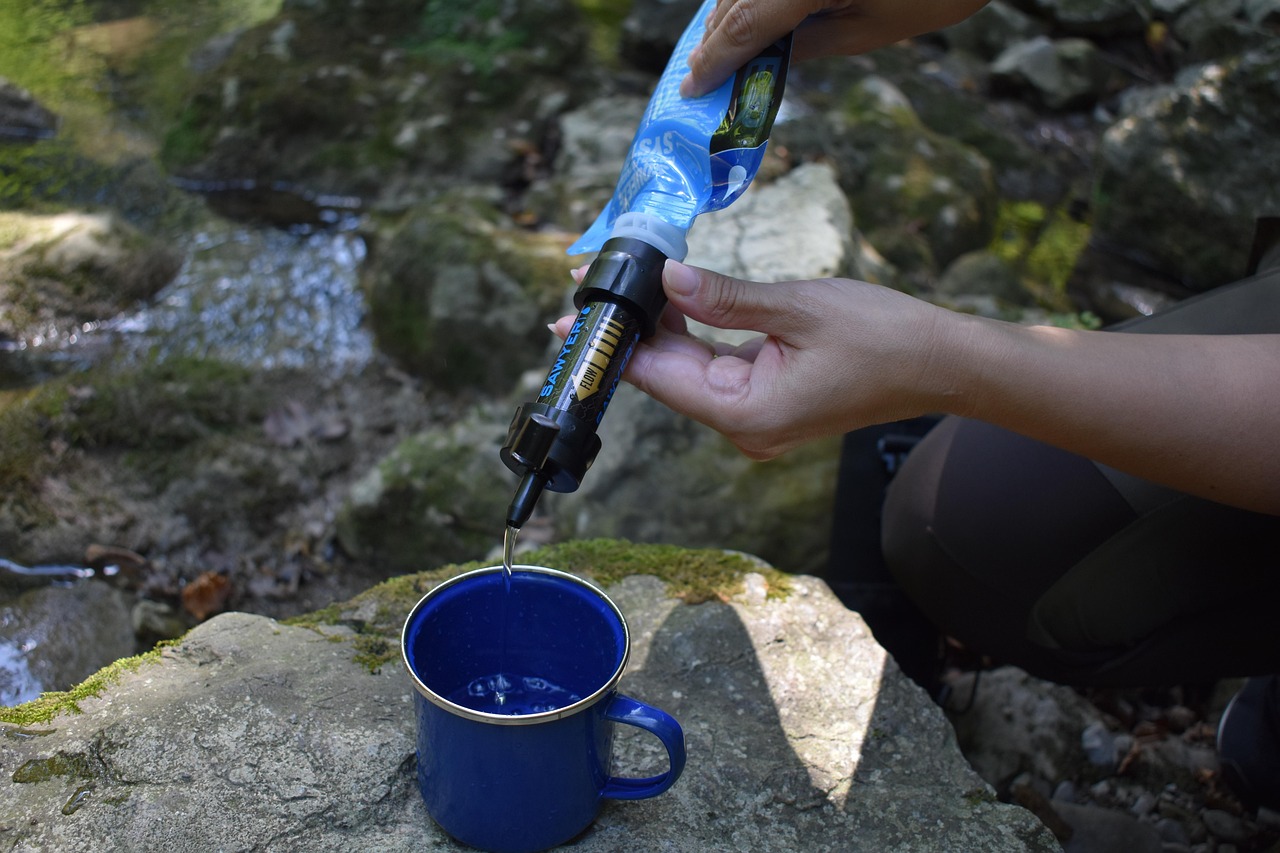
Sawyer Squeeze uses a 0.1-micron hollow-fibre membrane, removing 99.99999% of bacteria and 99.9999% of protozoa, and Sawyer rates the filter itself for up to 100,000 gallons (around 380,000 litres) — in practice, close to a lifetime filter for most users, though the specific 2-litre bladder that ships with some kits is rated separately at 1,000L before it needs care. The full kit (filter, pouch, cleaning syringe) weighs around 84–130g depending on the bundle, and current German retail pricing sits roughly in the 40–70 € range depending on kit size and retailer. Its defining feature is backflushing: the included syringe restores flow rate in the field, which is why long-distance thru-hikers tend to prefer it over filters that can’t be cleaned this way.
Katadyn BeFree also filters to 0.1 micron and removes bacteria, cysts and sediment, with a notably fast flow rate — up to 2 litres per minute according to Katadyn’s own figures — and the 0.6L version weighs just 59g. Its EZ-Clean membrane is cleaned by swishing the bag in water rather than backflushing with a syringe, which is faster in the moment but, per multiple independent reviewers and outdoor gear testers, needs doing more often and doesn’t restore flow as reliably over the long run as Sawyer’s syringe method. A recurring complaint in German-language reviews on Bergfreunde is a persistent plastic taste from the soft flask itself, which several buyers solved by transferring the filter onto a different brand’s pouch.
The practical difference in one line: Sawyer Squeeze for longevity and reliable field cleaning, Katadyn BeFree for the fastest flow rate and lowest weight if you’re willing to clean it more often.
Which one to actually buy
- Cheapest way to carry backup filtration: the original LifeStraw or the Peak Straw — both under 30 €, both fine for solo emergency use, neither great for actively filtering your whole day’s water supply since you can’t filter into a separate container to drink later.
- Best for actively filling bottles or bladders on a multi-day hike: Sawyer Squeeze, on the strength of its field-cleanable design and enormous rated lifespan.
- Best for fast refills mid-run or mid-ride: Katadyn BeFree, for the flow rate and low weight, accepting it needs more frequent cleaning.
- Best if you’re travelling somewhere with a real viral contamination risk: none of the straw/squeeze filters above — that’s specifically what LifeStraw’s Peak Gravity Purifier is built for, and it’s priced accordingly.
- Best if you just want an all-in-one bottle: LifeStraw Go, particularly the stainless steel versions if you also want the insulation.
None of these are a substitute for checking what’s actually in the water where you’re headed — hollow-fibre filters, from any of these three brands, are a bacteria-and-protozoa tool, not a universal purifier, and it’s worth knowing that distinction before you rely on one somewhere it wasn’t designed for.
Foto: MooreProtectionWien at www.pixabay.com