Stanley 1913 Drinking Bottles: Which One Is Good for Travel?
This article contains affiliate links
Stanley has been making vacuum-insulated steel bottles since 1913, which makes the brand roughly as old as the vacuum flask itself. For most of that century it was known mainly as the green hammertone thermos that went to work in a lunchbox. Then in 2023 the Quencher tumbler went viral on TikTok, and now “Stanley cup” is a term people use the way they’d say “Kleenex” — even when what they’re holding is a different Stanley product entirely. That popularity has muddied the range a bit, so here’s what the current EU lineup actually is, what each one costs, and — since that’s what you asked about — which of them genuinely makes sense to pack for a trip.
The Quencher: the one everyone means when they say “Stanley cup”
The Quencher is a double-wall vacuum insulated tumbler with a handle, sold in four main capacities: 0.59L, 0.89L, 1.18L and 1.9L. It comes in two lid styles that are the entire decision between them — the H2.0 FlowState lid rotates between a straw opening, a wide drinking opening, and a full cover, while the ProTour has a flip-up leakproof straw instead. Both are dishwasher safe, both are stainless steel, and Stanley is explicit that it’s built for cold drinks only — the wide opening and straw can deliver hot liquid to your mouth faster than expected, which is a scalding risk, not just a design quirk. EU prices run from around €45 for the 1.18L ProTour in standard colourways up to €60 for some finishes.
It’s a genuinely good desk, car and gym cup. For travel specifically, independent reviewers are fairly consistent on one point: the FlowState lid is splash-resistant, not leakproof, and it drips from the straw opening or lid edge if the tumbler tips over — in a bag, on a train table, in a car footwell. The ProTour’s flip straw closes more securely and is the better of the two for anything that moves around, but reviewers still describe it as leak-resistant rather than sealed. At nearly 1.2kg full in the largest size, it’s also heavier and bulkier than most people want clipped to a daypack.
Quencher ProTour Flip Straw Tumbler 0.89L — Stanley 1913
Classic Legendary Bottle: the actual thermos
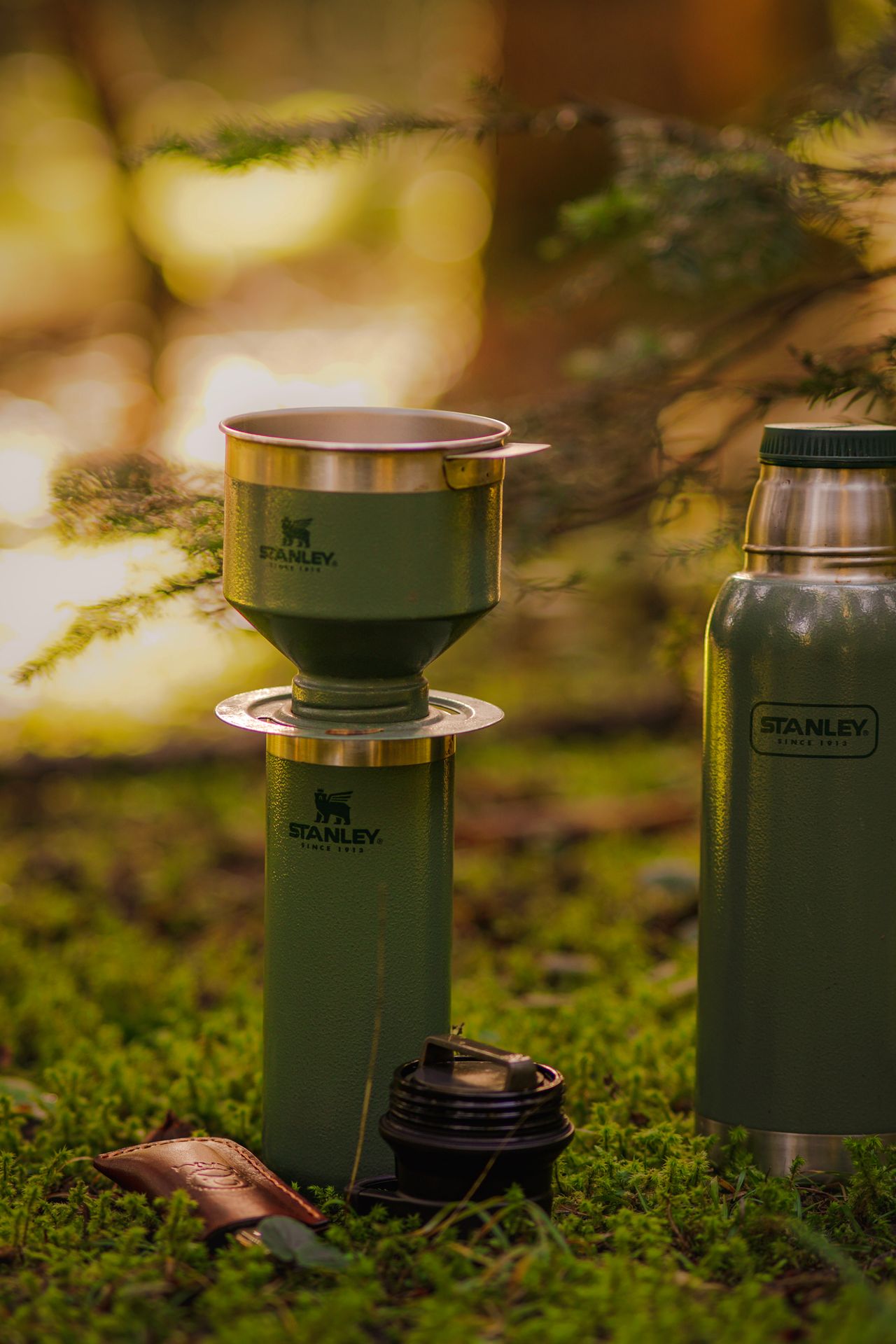
This is the older design — a slim vacuum flask with a twist-and-pour stopper and an insulated lid that doubles as a cup, sold from 0.47L up to 2.3L. According to Stanley’s own product specs, the 0.94L version keeps drinks hot for 24 hours, cold for 26 hours, and cold with ice for 5 days — figures that hold up because the sealed stopper design loses far less heat than an open tumbler lid. It’s recycled 18/8 stainless steel, BPA-free, and fully dishwasher safe. The 0.94L bottle weighs 639g and costs €65 in the EU store; smaller sizes cost less.
This is the one built for actually being carried somewhere rather than sitting on a desk. The narrow, symmetrical shape fits most bag side-pockets, the twist-and-pour stopper doesn’t leak when the bottle is lying flat in a backpack, and — unlike the Quencher — it’s rated and genuinely used for hot drinks, which matters if you want coffee at a trailhead six hours after you left the house.
Classic Legendary Bottle 0.94L — Stanley 1913
IceFlow: the middle ground
The IceFlow range sits between the two — a slimmer, cup-holder-shaped bottle with a flip-straw spout that snaps fully shut. Stanley’s own spec sheet calls it “leak resistant” rather than leakproof, which is a more honest description than “leakproof” marketing tends to use elsewhere, and matches what independent reviewers found in practice: sealed shut, it survives being tipped over far better than the Quencher’s open straw design, though it’s not rated for hot drinks at all (Stanley lists “N/A” for heat retention). The 0.71L version weighs 390g, holds cold for 10 hours, cold with ice for 2 days, and costs €45.
Practicability for travel: which one to actually pack
If you’re choosing between these three for a trip — flight, road trip, hike, city break — the trade-offs are genuinely different, not just cosmetic:
- For a flight or a day of city walking, the Classic Legendary Bottle is the strongest pick precisely because it doesn’t care which way up it’s packed. A sealed stopper survives a backpack being thrown around in an overhead bin in a way an open tumbler lid doesn’t, and it’s the only one of the three that keeps coffee hot for half a day.
- For a hike or anything that gets shaken around, the IceFlow’s snap-shut spout is the more travel-appropriate of the two cold-only designs — reviewers who specifically tested it upside-down and shaken report it holding, where the Quencher’s straw visibly drips.
- For a car, a desk, or a bag you’re not throwing around, the Quencher earns its popularity — better ergonomics, a handle that actually helps, and the biggest capacity in the range. It’s just not the one to trust in a backpack side pocket on a train.
One more thing worth knowing before buying any Stanley product: in early 2024, Stanley confirmed that the pellet used to seal the vacuum insulation at the base of its bottles contains lead, following viral social media testing. The company’s position, echoed by outside toxicologists at the time, is that the pellet sits under a sealed stainless-steel layer and isn’t accessible unless that base cover is damaged — a scenario Stanley describes as rare, and covered under its lifetime warranty if it happens. It’s a legitimate thing to be aware of, particularly for a bottle that’s going to take knocks on the road, but it isn’t a reason to avoid the brand outright; the manufacturing practice is common across vacuum-insulated drinkware, not unique to Stanley.
The short version
Buying for looks or a big desk cup: Quencher. Buying something to actually survive travel — hot coffee included — and not leak in your bag: the Classic Legendary Bottle. Buying a lighter cold-only bottle for hikes and gym bags where a sealed spout matters more than capacity: IceFlow.
Foto: dogadakisakal at www.pexels.com