Best SOS Devices for Hiking in 2026: 4 Devices Compared
This article contains affiliate links
Press the SOS button on a Garmin inReach and nothing dramatic happens at first. A cover flips up, you hold the button, and a 20-second countdown starts, which is your window to cancel if you pressed it by accident. Once it runs out, your GPS position goes to a staffed emergency center that starts texting you back.
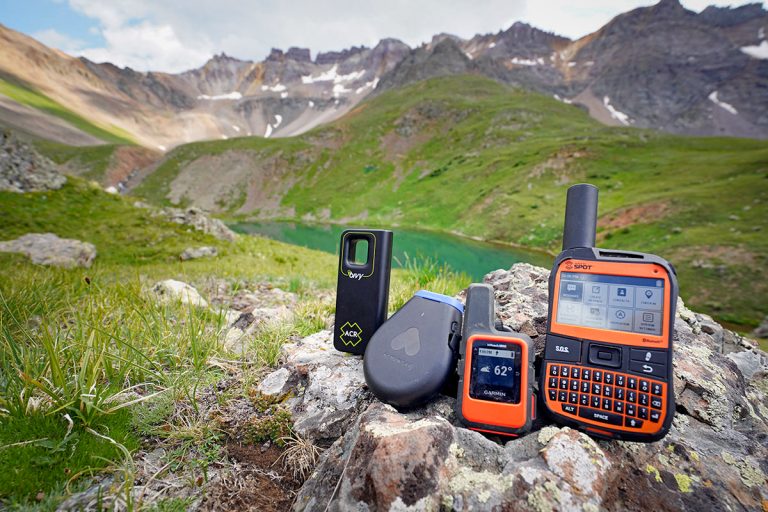
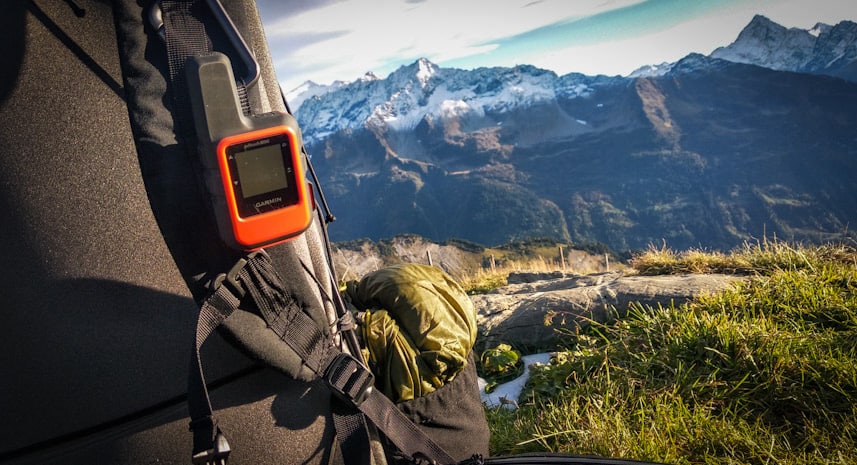
That small interaction is the reason people buy the best SOS devices for hiking. An SOS device, usually called a satellite communicator or satellite messenger, is a handheld unit that talks to satellites instead of cell towers. The four in this guide weigh between 100 and 150 grams. You clip one to a pack strap, and it gives you three things a phone cannot promise on a remote trail: an SOS button that reaches a 24/7 monitoring center, two-way text messaging, and a way for family to see where you are.
The problem it solves is simple. Your phone is a good tool until the trail drops out of cell range, which happens sooner than most people expect once you leave the popular routes. A satellite communicator works from anywhere with a view of the sky, and it does not care whether you have bars.
It matters most for solo hikers and for anyone heading into terrain where help is hours away. It matters less on a busy trail with steady phone signal, where a charged phone is usually enough.
This guide compares four devices: the Garmin inReach Mini 3 Plus, the older Mini 2, and two cheaper alternatives, the ZOLEO and the Garmin inReach Messenger.
How an SOS device for hiking actually works
All four devices here use the Iridium satellite network, which covers the whole planet. That is why they work in places a phone-based satellite feature may not. The device sends your position and messages up to a satellite, and a monitoring center on the ground takes it from there.
Two things are worth understanding before you spend money. First, the center coordinates the rescue, it does not perform it. Garmin’s Response center, for example, contacts the local rescue agencies for your location. Second, every one of these devices needs a paid subscription to use satellite features. No plan, no SOS. The hardware price is only half of what you pay.
Most rescues cost the person nothing. If a private helicopter or air ambulance ends up involved, the bill can run into the thousands, and that is a separate problem from the subscription. Rescue insurance exists for exactly that gap.
A realistic use case: a twisted ankle two hours from the trailhead
The scenario below is hypothetical, but it follows how these devices behave according to the reviews we used.
Picture a solo day hiker on a ridge route with no cell signal. Two hours from the car, a foot lands badly on loose rock and the ankle will not take weight. Walking out is not an option, and nobody is expecting a message until evening.
With a satellite communicator clipped to the pack, the sequence is short. The hiker lifts the cover, holds the SOS button and lets the countdown run. On the Garmin units there are 20 seconds to cancel before the alert goes out. The device sends a GPS position to Garmin Response, a staffed center that coordinates with the local rescue agencies for that location and starts messaging the hiker back. The hiker answers the dispatcher’s questions on the device itself. Nobody needs to walk to a high point to find a signal.
This is where the device choice changes the conversation:
- Mini 3 Plus: the hiker can record a 30-second voice note or send a photo of the ankle and the terrain through the paired phone app. HikingGuy measured messages under a minute, voice notes at 1 to 3 minutes and photos at 2 to 5 minutes. As rescuers get close, the emergency siren helps them find the right patch of hillside.
- Mini 2 and Messenger: SOS and text work the same way, but every detail has to be typed in short messages, 160 characters at a time. That is slower, though fine for a clear problem.
- ZOLEO: the SOS button works on the device alone. If the phone is damaged or out of battery, though, two-way messaging stops, and the dispatcher conversation depends on the phone being alive.
The same device earns its keep on days when nothing goes wrong. A weekend backpacker can send a preset “I’m OK” check-in each evening, which tells family the location without a long text, and a shared tracking page lets them see the route. The SOS button is the reason to own one, but the everyday value is in the check-ins.
The four devices at a glance
| Garmin inReach Mini 3 Plus | Garmin inReach Mini 2 | ZOLEO (1500 model) | Garmin inReach Messenger | |
|---|---|---|---|---|
| List price (approx.) | $499.99 | $399.99 | $199 | $299 |
| Weight | 125 g | 100 g | 150 g | 114 g |
| Screen | 1.9″ color touchscreen | Small, button-driven | None (LEDs only) | Small, button-driven |
| Standalone two-way texting | Yes | Yes | No, needs phone | Yes (clunky) |
| Photo and voice messages | Yes | No | No | No |
| Battery, tested by reviewers | 130-300 h (low power, 10-min tracking) | Up to 288 h | About 190 h | About 20 days |
| Best for | Heavy use, bad weather, groups | Solid core SOS | Phone-first hikers | Battery life, best value |
Garmin inReach Mini 3 Plus: the best SOS device for hiking if money is no object
This is the one to beat. The reviewer behind HikingGuy carries it as his primary device after hundreds of trail miles and reports no crashes, which matters more than it sounds, because two other Garmin handhelds he tested had stability problems.
What you get over the Mini 2 is practical rather than flashy. A touchscreen with a proper keyboard makes typing a message bearable. A 30-second voice note replaces what would otherwise be several minutes of thumb-typing, and photos let you show a rescuer a swollen ankle or a washed-out trail junction. Text messages stretch to 1,600 characters instead of 160. There is also an emergency siren, which the same reviewer heard clearly at 500 feet in heavy vegetation.
Under the hood it moved to a different Iridium protocol (Certus/IMT) that allows larger messages. The same reviewer rates its performance under tree cover as the best of the three Minis.
The weak spots are worth knowing. The Mini 3 Plus has no camera, so photos come from your phone through the Garmin Messenger app. The color screen is mostly wasted, because the onboard map shows towns and cities only, with no trails or terrain. You can load detailed maps in the Explore app on your phone, but not on the device. Battery life also fell short of the spec sheet in testing: Garmin claims up to 350 hours in low-power mode with 10-minute tracking, and the reviewer measured somewhere between 130 and 300. Switch to performance mode and you are looking at 50 to 60 hours, not the claimed 95.
Voice and photo messages cost more than standard texts, and the cheaper plans cap them. At $495 before the subscription, this is also the most expensive way to carry an SOS button.
Buy it if you hike in groups, in remote terrain, or somewhere a clear voice note could change how a rescue goes. Skip it if you only want the SOS button and a few check-ins.
Buy here the Garmin inReach Mini 3 Plus
Garmin inReach Mini 2: the sensible choice when you do not need photos
Launched in 2022, the Mini 2 does the core job: SOS, two-way text, tracking, TracBack routing and weather. It weighs 100 grams, the lightest of the Garmin options, and one long-term owner reports three years of use as a staple of his hiking kit. If all you need is SOS, the Mini 2 does it.
You give up the touchscreen, the color display, the siren, multi-band GPS and the photo and voice features. Texting means scrolling through letters with buttons, or pairing it with your phone. The Mini 2 has no basemap at all.
Battery is its quiet strength. Garmin quotes 336 to 350 hours at 10-minute tracking, and the reviewer saw up to 288, which is not far behind the newer unit’s real-world numbers despite the smaller 1,250 mAh cell.
Availability is the catch. At least one retailer now lists it as discontinued with the Mini 3 as the replacement. List price was $399.99, but it has turned up around $295 at big retailers.
Buy it if you find it discounted and want the least weight on your pack strap. Skip it if you will be typing a lot of messages or want photos and voice.
Buy here the Garmin inReach Mini 2
ZOLEO: the cheap option that works best with your phone
The ZOLEO costs $199 for the current white 1500 model, and the older 1000 model was $149 before it was replaced. It has no screen. You get a few buttons and LEDs, and for anything beyond an SOS or a preset check-in you need your phone and the ZOLEO app.
That dependence is the real trade. If your phone dies, breaks or loses Bluetooth, the ZOLEO becomes a one-way distress and check-in device. Garmin’s units still let you send a text from the device itself.
What you get in return is the nicest messaging setup in the category. The ZOLEO has its own phone number and email address, and the app switches between cell, Wi-Fi and satellite on its own. A friend can text your ZOLEO number and the message finds you, whichever network is closest. Battery tested at about 190 hours with message checks every 12 minutes, which is around eight days. SOS runs through Global Rescue and Medical Assist messaging is included.
The plans are where it gets less cheap than it looks. There is a $19.99 activation fee and a 3-month minimum. The Prepare plan is $19.99 a month for 50 satellite messages, with extras at $0.50 each. Protect is $34.99 for unlimited. Pausing costs $4.50 a month. The breadcrumb tracking extra, Location Share+, adds $6.
Buy it if you already carry your phone everywhere and want a simple, reliable messenger. Skip it if you want a device that works on its own when the phone is gone.
Buy here the ZOLEO Satellite Messenger
Garmin inReach Messenger: the cheaper Garmin that wins on battery
The Messenger is Garmin’s answer to the ZOLEO, at a list price of $299. It weighs 114 grams, charges over USB-C, and runs the same Iridium network and the same Garmin Response center as the Minis.
Battery is the headline. Garmin claims up to 28 days, and the reviewer measured around 20, which is more than double the ZOLEO. It also uses multiple satellite positioning systems where the ZOLEO uses GPS and GLONASS only, and it offers limited navigation functions.
It is not a pleasant device to type on. The screen and buttons are small, and Garmin designed it to work with a paired phone. But if the phone dies, you still have two-way text, which is more than the ZOLEO can say. It does not do photos or voice.
Buy it if you want Garmin’s SOS and long battery at the lowest Garmin price. Skip it if you will be sending lots of messages from the device itself.
Buy here the Garmin inReach Messenger
One more worth a look: the ACR Bivy Stick
The Bivy Stick lists at $199.95 (it was $349 before ACR cut the price), weighs 100 grams, and is rated IPX7 with up to 120 hours of battery. Like the ZOLEO it leans on your phone, and it also has a dedicated phone number, GoPro-compatible mounts and SOS through Global Rescue. Plans start at $14.99 a month. We left it out of the main four because the criticism centers on plan pricing: the most helpful critical review on REI (112 helpful votes) complains about pricing changes after the device price dropped. Check the current plan terms before you commit.
What the subscription really costs per year
This is the part most buying guides skip. Garmin’s plans are the same whichever inReach you own, because Garmin charges for the plan and not the device. Current US pricing:
| Plan | Per month | Included texts and weather | Photo or voice | Tracking |
|---|---|---|---|---|
| Enabled | $7.99 | Pay per use ($0.50 each) | $1.00 each | $0.10 per point |
| Essential | $14.99 | 50 | 25 | $0.10 per point |
| Standard | $29.99 | 150 | 50 | Unlimited |
| Premium | $49.99 | Unlimited | Unlimited | Unlimited (2-min) |
On top of that there is a one-time $39.99 activation fee. You can suspend a plan at no cost for up to 12 months with no reactivation fee, and on compatible devices the SOS keeps working while suspended. Check Garmin’s compatible-device list for your exact unit before you rely on that. Canceling instead wipes your data and charges the activation fee again, so suspend if you only hike seasonally.
Here is year one if you stay on the cheapest plan the whole time with light messaging, based on list prices:
- inReach Mini 3 Plus: $499.99 + $39.99 + $95.88 = about $636
- inReach Mini 2: $399.99 + $39.99 + $95.88 = about $536
- ZOLEO: $199 + $19.99 + $239.88 (Prepare plan) = about $459
- inReach Messenger: $299 + $39.99 + $95.88 = about $435
The ZOLEO looks cheap on the shelf and ends up costing more than the Messenger in year one. Real costs shift with how you use it, and suspending in the off-season brings them down. HikingGuy’s calculator points most people to the Enabled plan, at roughly $146 a year depending on tracking and messages.
Which one should you buy?
Pick the Mini 3 Plus if you want the best device and can accept the price, especially for group trips or terrain where describing an injury in 160 characters would not be enough.
Pick the Messenger if you want Garmin’s SOS and the most battery for the least money. For most day hikers and weekend backpackers, this is where we would point you.
Pick the ZOLEO if your phone is always with you and you value a number your family can text directly. Budget for the plan as well as the device.
Pick the Mini 2 only if you can find it discounted. At list price the newer units are better value, and some retailers are already phasing it out.
One practical point: whichever you choose, set up and test the device before the trip, not at the trailhead. Send a message, check that your contacts receive it, and learn where the SOS button is. A device you have never used is a worse emergency tool than one you have.
FAQ
Do I need a subscription for an SOS device? Yes, for every device in this guide. Without an active plan the satellite features, including SOS, do not work. Garmin lets you suspend a plan for free for up to 12 months, which keeps costs down for seasonal hikers.
Is a satellite communicator better than a personal locator beacon? A PLB sends an SOS and nothing else. A communicator also lets you message, so you can tell rescuers what is wrong and cancel a false alarm. The cost is the ongoing subscription.
Do these devices work without cell service? Yes. They use the Iridium satellite network, which covers the whole planet. You need a reasonably clear view of the sky, and dense tree cover slows messages down.
Can I use my phone instead? Some phones now offer satellite messaging, but reviewers point out that it usually needs manual checks and drains the phone battery. A dedicated device keeps working when your phone is dead, and that is when you most need it.
Which is the best SOS device for hiking for beginners? The inReach Messenger or the ZOLEO. Both are simple, and both cost less up front than the Minis.
Prices and plan terms were checked in October 2026 and can change.