DJI Osmo Pocket 4 vs Pocket 4P: Which One Should You Buy?
This article contains affiliate links
I’ve been going back and forth on this for weeks: DJI launched the standard Osmo Pocket 4 in April 2026, then followed it up just a few months later with the Pocket 4P, a dual-lens version that costs more and does genuinely different things. If you’re trying to figure out which one to put in your travel bag, the short answer is that the gap between them is bigger than the “P” suggests — but not in the way DJI’s marketing makes it sound.
The quick answer
If you shoot mostly wide vlogging footage — walking shots, room tours, one-person-talking-to-camera — the standard Pocket 4 does everything you need and costs less. If you regularly want a tighter, more flattering shot (interviews, portraits, distant subjects) without digital cropping, the 4P’s second lens earns its price.
DJI Osmo Pocket 4 — DJI Osmo Pocket 4P
What’s actually different between them
Both cameras share the same core idea: a 1-inch CMOS sensor on a mechanically stabilized 3-axis gimbal, in a body that fits in a jacket pocket. Where they split is the lens setup. The Pocket 4 has one lens — a 20mm-equivalent wide angle at f/2.0. The Pocket 4P has two physical lenses: that same 20mm f/2.0 wide, plus a 60mm-equivalent telephoto at f/1.8 with 3x optical zoom (up to 12x combined with digital zoom). Switching between them during a shot isn’t a digital crop — it’s a genuine lens change, and DJI says the transition is designed to look seamless in footage.
The 4P’s wide lens also uses a newer sensor design (DJI calls it LOFIC) paired with a new 10-bit color profile, D-Log 2, that the standard Pocket 4 doesn’t have. DJI’s headline claim is 17 stops of dynamic range on the 4P versus 14 stops on the Pocket 4. Worth flagging: PetaPixel’s review found the 4P’s real-world dynamic range fell short of that 17-stop claim, even though image quality from the main camera was still excellent. Treat the number as a marketing ceiling, not a guaranteed result.
The telephoto lens on the 4P is a step down from the wide lens in a few ways — it uses the older D-Log profile, tops out at 4K/200fps instead of 4K/240fps, and doesn’t get the extended dynamic range. It’s there for reach and portrait-style compression, not for matching the wide lens shot-for-shot.
Comparison
| Osmo Pocket 4 | Osmo Pocket 4P | |
|---|---|---|
| Lenses | Single, 20mm equiv. | Dual: 20mm equiv. wide + 60mm equiv. tele |
| Wide sensor | 1-inch CMOS, f/2.0 | 1-inch CMOS (LOFIC), f/2.0 |
| Tele sensor | — | 1/1.28-inch CMOS, f/1.8 |
| Optical zoom | 2x lossless (digital crop) | 3x optical (wide-to-tele switch) |
| Combined zoom range | Up to 4x | Up to 12x |
| Minimum focus distance | Not specified by DJI | Wide: 9 cm / Tele: 20 cm |
| Dynamic range (claimed) | 14 stops | 17 stops (wide lens only) |
| Color profile | 10-bit D-Log | 10-bit D-Log 2 (wide) / D-Log (tele) |
| Max video resolution | 4K/240fps | 4K/240fps (wide) / 4K/200fps (tele) |
| Photo resolution | 37 MP | ~37 MP |
| Weight | 190.5 g | 230 g |
| Dimensions | 144.2 × 44.4 × 33.5 mm | 159.5 × 63.3 × 33.5 mm |
| Touchscreen | 2.0-inch, 556×314, 1000 cd/m² | 2.0-inch, 556×314, 1000 cd/m² |
| Internal storage | 107 GB | 103 GB |
| microSD expansion | Up to 1 TB | Up to 1 TB |
| Battery capacity | 1,545 mAh | 1,545 mAh |
| Rated runtime | ~210 min | ~210 min |
| Fast charging | 80% in 18 min | 80% in 18 min |
| Microphones | 3 internal | 3 internal |
| Connectivity | Wi-Fi 6, Bluetooth 5.4 | Wi-Fi 6, Bluetooth 5.4 |
| USB transfer speed | Up to 800 MB/s | Up to 800 MB/s |
| Subject tracking | ActiveTrack 7.0 | ActiveTrack 8.0 |
| Colors | Graphite | Black, Pearl White |
| Base price (official EU) | 499 € (Standard Combo) | 599 € (Standard Combo) |
| US availability | Not officially sold | Not officially sold |
A 40-gram, 15mm difference doesn’t sound like much written down. In practice, several reviewers noted the 4P feels noticeably top-heavy compared to the Pocket 4, since the extra lens housing sits above the same slim handle. If you’re used to one-handed Pocket 3 or Pocket 4 shooting, expect a slight adjustment period.
Price and where you can actually buy one
This is the part that matters more than any spec sheet. Neither camera has an official US launch. DJI’s newer products have been caught up in ongoing FCC and import restrictions in the US, and multiple outlets — Tom’s Guide, Engadget, PetaPixel among them — confirmed at launch that both the Pocket 4 and Pocket 4P shipped everywhere except the United States. US buyers can find units through third-party importers and resellers, but at prices DJI doesn’t control and without official US warranty support. If you’re in Europe, both are sold directly through the official DJI Store, and those are the prices worth anchoring on:
- Osmo Pocket 4: 479 € for the Essential Combo, 499 € for the Standard Combo, and 619 € for the Creator Combo (adds mic, fill light, wide-angle lens, battery handle).
- Osmo Pocket 4P: 599 € for the Standard Combo, 689 € for the Vlog Combo (adds the FrameTap remote, fill light, Mic Mini 2 transmitter, mini tripod).
That puts the 4P at 100 € more than the Pocket 4 at entry level, and 70 € more at the fuller bundle. Prices are DJI’s official EU store prices at time of writing and can shift with promotions, so check current pricing before buying.
DJI Osmo Pocket 4 — DJI Osmo Pocket 4P
Where they’re identical
It’s easy to assume the 4P is an upgrade across the board, but the table above shows how much is actually shared: screen, battery, charging speed, storage architecture, and connectivity are all the same. Both also max out at 4K — if you specifically want 8K, this isn’t where you’ll find it, and a direct competitor like the Insta360 Luna Ultra shoots 8K for a similar price bracket.
One shared limitation worth knowing before you buy
On both cameras, Log color profiles aren’t available in slow-motion or timelapse modes — you’re locked to the standard color profile above 60fps, which means less flexibility if you plan to color-grade slow-mo footage. It’s a small thing, but if slow-motion b-roll is a big part of your workflow, it’s worth knowing going in rather than discovering it after your first edit.
My take
For most people traveling or vlogging solo, the standard Pocket 4 is the better buy. It’s lighter, cheaper, and the single wide lens covers the majority of what people actually use these cameras for. The 4P’s telephoto lens is genuinely useful — real optical reach and portrait compression beat digital crop every time — but it’s a specific-use upgrade, not a universal one. If you regularly shoot interviews, product close-ups, or want to frame subjects tighter without walking closer, the 4P earns its extra cost and weight. If not, save the money and the pocket space.
And if you’re reading this from the US: check current availability before you commit either way. The situation has been shifting month to month, and buying through an unofficial importer carries real risk that a spec comparison won’t show you.
DJI Osmo Pocket 4 — Creator Combo — DJI Osmo Pocket 4P — Vlog Combo
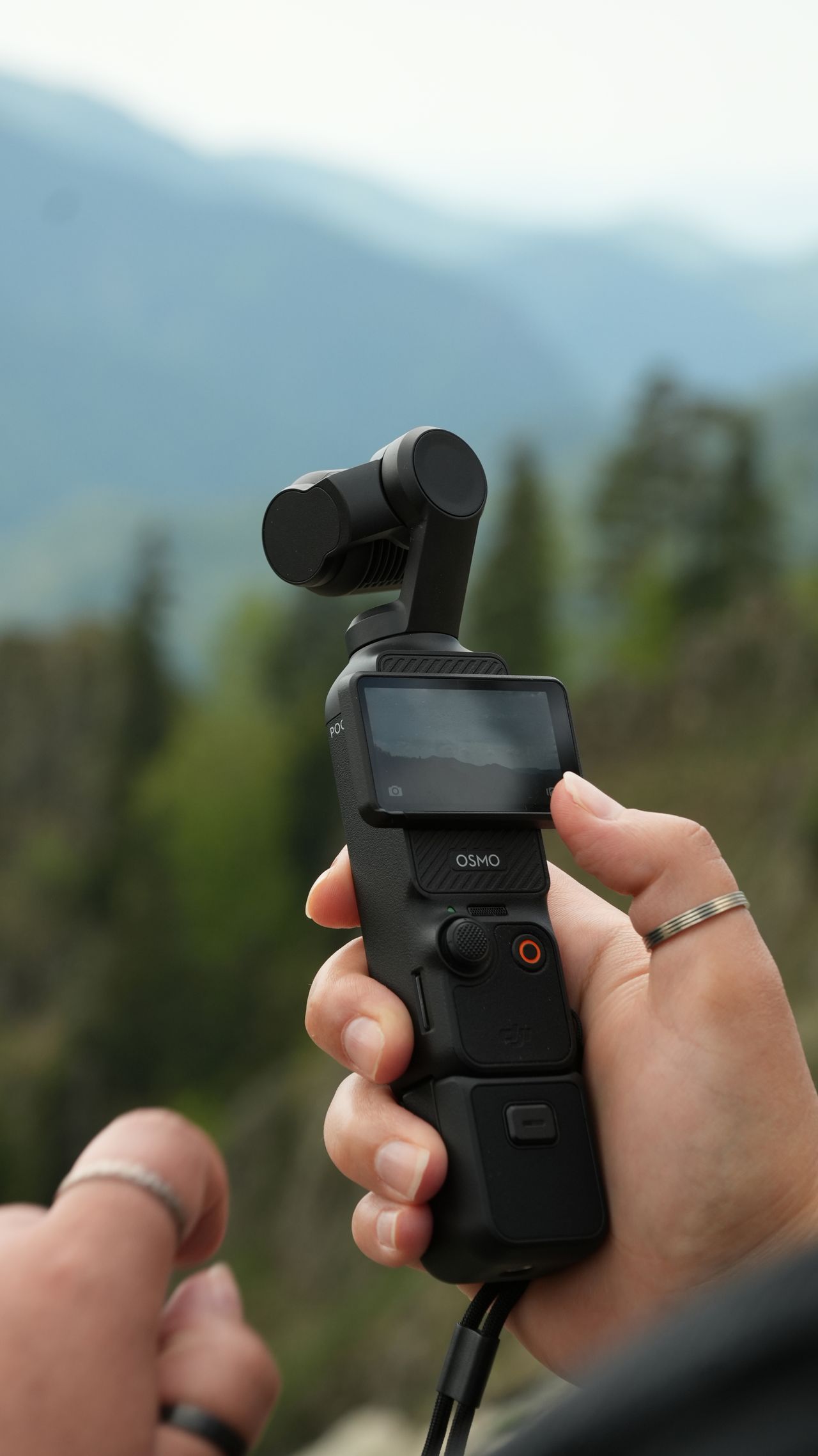
Foto: Cemrecan Yurtman at www.pexels.com